

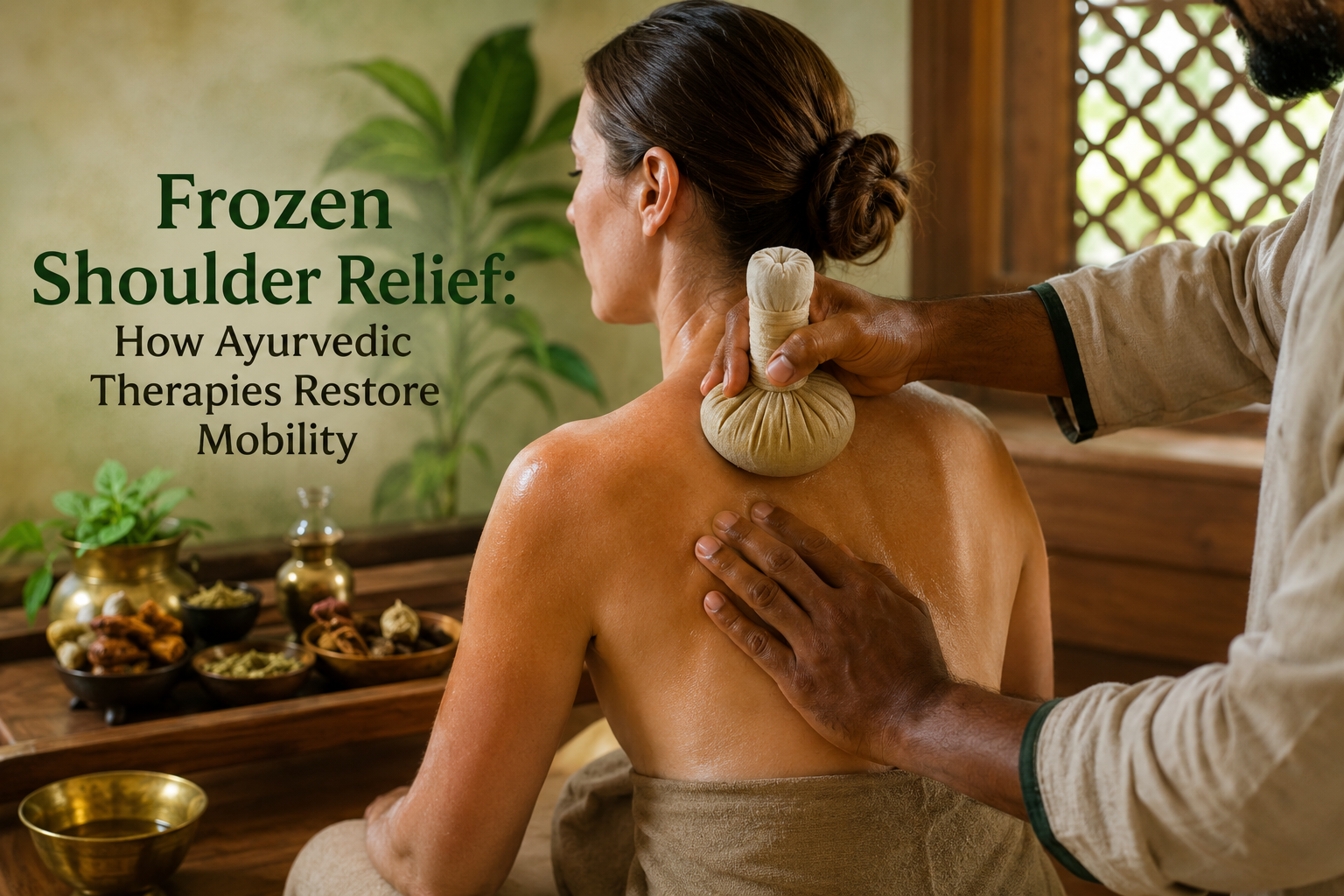
Frozen shoulder (adhesive capsulitis) is a condition patients often describe as one of the most frustrating they’ve experienced — a slow, progressive stiffening of the shoulder joint that can make simple tasks like reaching for a shelf or fastening a seatbelt genuinely painful. Unlike an acute injury with an obvious cause, frozen shoulder often develops gradually, which means many patients don’t seek treatment until the stiffness is already significant.
Understanding the three stages
- Freezing stage — gradual onset of pain with increasing stiffness, often the stage where patients first notice something is wrong but may dismiss it as a minor strain
- Frozen stage — pain may reduce, but stiffness peaks, severely limiting range of motion and making everyday tasks difficult
- Thawing stage — mobility slowly returns, sometimes over many months, and this is often the stage where patients feel encouraged but impatient with the pace of recovery
In Ayurveda, frozen shoulder is classified under Vata Vyadhi, where aggravated Vata dries out the synovial fluid and connective tissue around the shoulder joint, leading to restricted movement and inflammation. See a related frozen shoulder case study from our records for a closer look at how a typical case progresses through treatment.
How Ayurveda approaches recovery
Kativasthi-style localized oil pooling adapted for the shoulder region — deeply nourishes the joint capsule with warm medicated oil, held in place over the shoulder for an extended period to allow deep penetration.
Kizhi (herbal bolus massage) — reduces stiffness and improves local circulation through warm herbal poultices worked into the shoulder and surrounding muscles.
- Abhyanga — full-body oleation that supports overall Vata balance, since frozen shoulder is often connected to a broader systemic Vata imbalance rather than a purely local issue
- Snehapanam — internal oleation to address systemic Vata aggravation from within, working alongside the external oil therapies
- Guided mobility exercises, introduced progressively as pain reduces, to prevent further stiffening without overstraining the joint
Why timing matters
Patients who begin treatment during the freezing stage typically see faster improvement than those who wait until the joint is fully frozen, since there is generally more mobility left to preserve. Even long-standing cases often respond well to a structured in-patient program, since Ayurvedic therapy addresses both the local joint stiffness and the underlying Vata imbalance driving it, rather than just working on the shoulder in isolation.
Life after treatment
Most patients are advised on a home-care oil massage and stretching routine to maintain gains after discharge, since frozen shoulder can be slow to fully resolve even with excellent treatment. Consistency with the home routine, especially in the months following discharge, tends to make the biggest difference in how completely mobility is restored. Patients who have been through a full thaw describe the improvement as gradual but steady, which is a helpful expectation to set from the very beginning of treatment rather than expecting an immediate resolution.
How frozen shoulder differs from a simple shoulder strain
One of the most common points of confusion is distinguishing frozen shoulder from a rotator cuff strain or general shoulder pain, since both can involve pain and reduced movement. A key distinguishing feature of true frozen shoulder is that stiffness affects movement in essentially all directions, not just the specific motion that triggers pain in a typical strain. A proper physical assessment is important before starting any treatment protocol, since the underlying approach differs depending on the actual diagnosis.
What patients are often surprised to learn
Left untreated, frozen shoulder can take one to three years to fully resolve on its own, moving slowly through the freezing, frozen, and thawing stages — which is one of the main reasons patients seek treatment in the first place, to shorten this timeline and reduce the discomfort experienced along the way. Recurrence in the same shoulder after full recovery is uncommon, though some patients do go on to develop it in the opposite shoulder in future years, particularly if the same underlying Vata imbalance and lifestyle factors are still present. It’s also common, and often confusing, for pain to reduce even as stiffness gets worse — this is simply a hallmark of the transition from the freezing stage into the frozen stage, not a sign that something is going wrong, and understanding this pattern helps set realistic expectations for what recovery through each stage actually looks like.
Frozen shoulder can feel discouraging in the middle stages, when stiffness is at its peak and progress feels slow. A structured treatment plan, combined with patience through each stage, is generally what leads to the most complete recovery of mobility.
